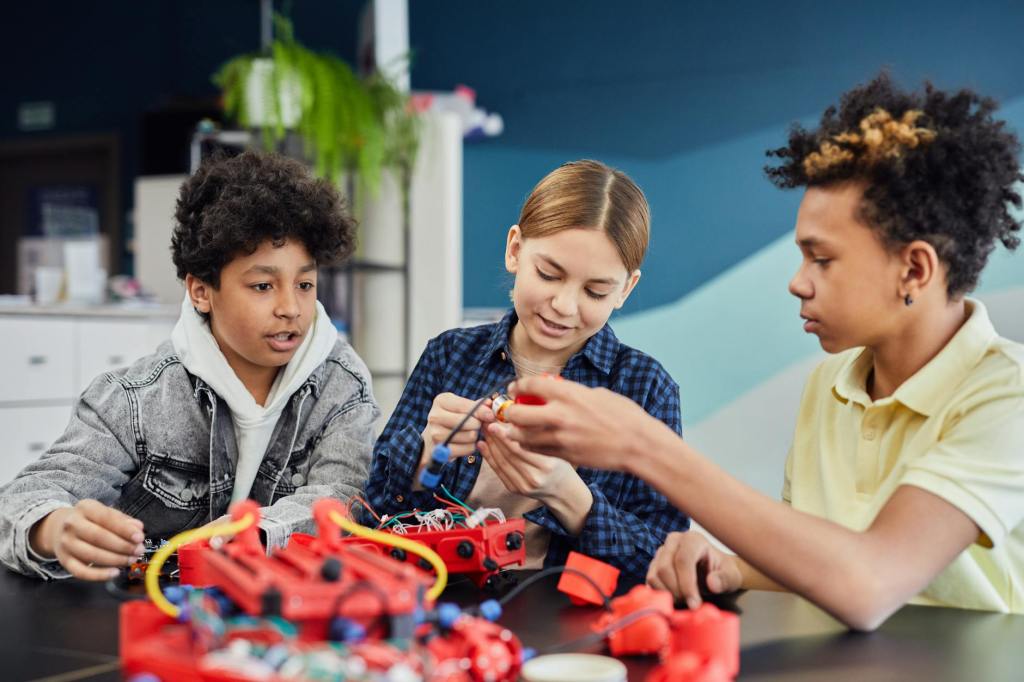
When it comes to assessments, the old-school methods—think multiple-choice quizzes and fill-in-the-blank tests—are like that one teacher who still uses an overhead projector: reliable, but a little uninspiring. Sure, they check the basics, but do they capture the full brilliance of your students’ brains? Enter the creative assessments, the funky new substitute teachers of the evaluation world. They’re here with role-plays, podcasts, and infographics, turning the classroom into a dynamic space where students don’t just memorize—they innovate, collaborate, and actually enjoy showing what they know. Because let’s face it, learning isn’t one-size-fits-all, and assessments shouldn’t be either!
Concept Mapping (Canva)
Students create visual maps connecting ideas and concepts, showing their understanding of relationships between topics.
Peer Teaching (ACSD)
Students explain concepts to their peers, demonstrating their understanding and communication skills.
Socratic Seminars (Facing History)
Students engage in an open-ended discussion, exploring and debating topics to demonstrate critical thinking.
One-Minute Essays (GMU)
Students write brief, focused responses to a question or prompt in one minute.
Quizizz
Students participate in competitive, interactive quizzes to assess knowledge in a fun way. Quizizz is my favorite of the bunch (Blooket, Kahoot, Gimkit, etc.) because it combines self-pacing (read: differentiation) with gamification. Plenty of features in the free version, and the subscription is worth it if you find that you are using the platform on a regular basis.
Infographics (Canva)
Students design infographics summarizing key concepts and data.
Fishbowl Discussions (Facing History)
Though similar to a Socratic Seminar, Fishbowls are more structured. An Inner circle of students discusses a topic while the outer circle observes and provides feedback. Then the groups switch, or students can “tag” in.
Case Studies (Edutopia)
Students analyze real-world scenarios, applying their knowledge to solve problems or make decisions.
Role-Playing or Simulations (Northern Illinois University)
Students take on roles in historical or real-life scenarios to apply their knowledge creatively.
Create an Artifact (Historica Canda)
Turn your classroom into a museum and have your students create artifacts that demonstrate their knowledge. For example, types of indigenous dwellings, devices that use a spring, or models of a part of the body.

 Lists for teachers
Leave a comment